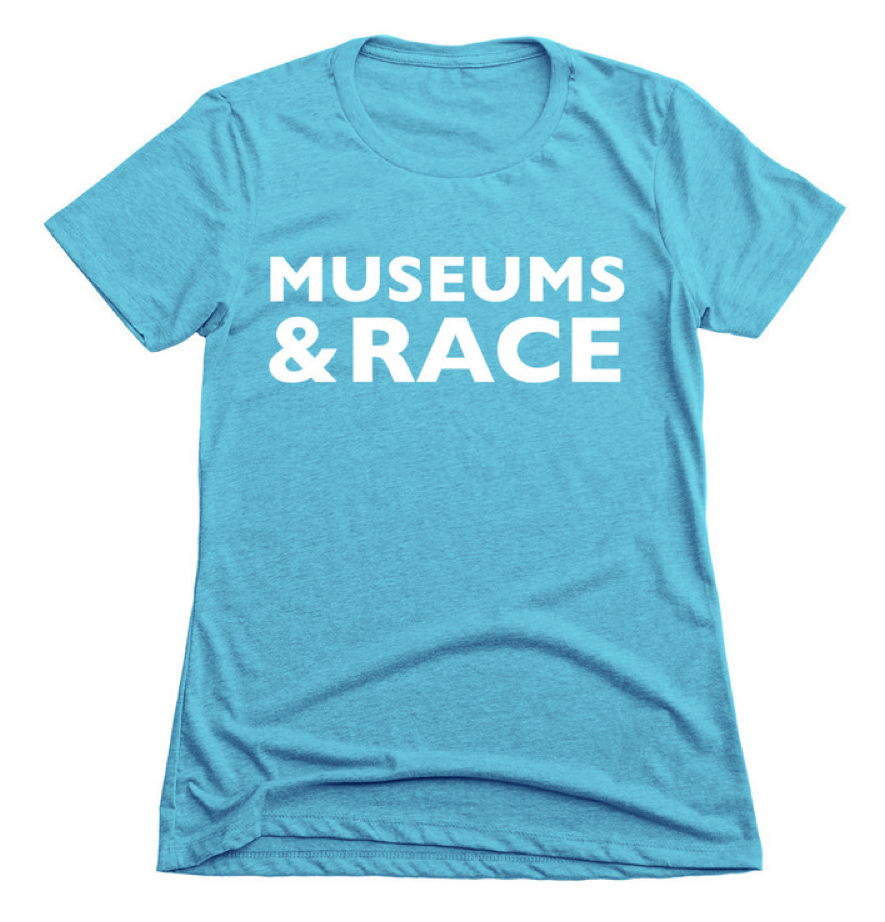
We heard you! And the Museums & Race T-shirts are back up on on Bonfire. Get yours just in time for the next conference circuit!
Now, in hoodie flavors, too.

We heard you! And the Museums & Race T-shirts are back up on on Bonfire. Get yours just in time for the next conference circuit!
Now, in hoodie flavors, too.

Folx asked about the Skittle-licious shirts at AAM 2018. Here’s your chance! We have a Bonfire campaign running through June 2.
Proceeds will support Museums and Race grants to help defray costs of conference attendance for emerging professionals of color. Details to come. Stay tuned!!


Museums & Race
Community Center and Transformation Lounge
at the American Alliance of Museums 2017 Annual Meeting
May 8 & 9 2017 – in the MuseumExpo
Museums and Race is a movement to challenge and re-imagine institutional policies and systems that perpetuate oppressions in museums. We are a group of museum professionals who are interested in effecting radical change in our field. Our work is (1) to persuade our colleagues that it is necessary to adopt a new philosophical stance on the role of the museum that is both morally and culturally responsive and grounded in empathy, respect, and inclusion and (2) to build and grow a movement toward examining and ultimately transforming institutional policies. Museums & Race joins efforts with colleagues focused on this work.
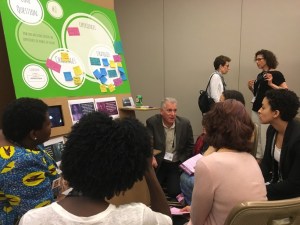
The American Alliance of Museums has provided space at the annual meeting in St. Louis this May to support this movement. There Museums and Race will host a Community Center and Transformation Lounge – a space to recharge, engage in self-reflection, connect with others and share resources about justice and transformation across our professional field. The Community Center and Transformation Lounge will be a hybrid drop in space in the MuseumExpo that includes interactive activities and pop-up presentations that encourage connecting with others involved in justice-centered work and open dialog.
The Museums & Race Community Center and Transformation Lounge will be open on Monday, May 8 from 11:45 am to 5:30 pm and on Tuesday, May 9 from 10:00 am to 5:30 pm.
We have attempted to schedule programming during times when conference activities with a similar focus are not taking place to provide a platform for continued discourse and sharing of ideas and practice across the field.
Join us for:
The Lightning Talks are designed for museum professionals to speak truth to power on intersectionality, privilege, systems of oppression, institutional legacies and other related topics. The talks will be informational, inspirational and conversational. Some of the topics that will be covered include decolonizing museums, Afro Latinx identity, community engagement and more!
Come to inspire and be inspired! ! For more details and additional announcements, follow us on Twitter & Instagram at @MuseumsandRace; follow us on Facebook. We invite everyone to use the #MuseumsandRace and #AAM2017 hashtags on social media to share justice and transformation related discussions, sessions, and presentations among ourselves and with our broader community online!

More than 400 people registered for the Gathering in advance; about 300 people participated in activities in the Transformation Lounge and 200 people participated in sessions. The interest from diverse races and ethnicities shows the vital role Museums & Race can play in creating a cross-race platform for honest dialogue.
The best way to understand how closely the Museums & Race Gathering addressed its goals, listed below, is to click on the link to the summarized survey results here. Notes left on Post-its in the Transformation Lounge are also very revealing.
As the first event of this magnitude to occur at a museum conference, the Gathering was an experiment, and it was a significant learning experience for those who participated, planned and facilitated it. The survey results show that participants had positive experiences at sessions and in the Transformation Lounge, and that there was a great turnout for this important topic. There were significant issues with registration, check-in, and with one of the sessions (Session 2: Constructing Spaces for Honest Conversations About Race). A blog post following up on the Gathering, taking responsibility for the issues, was posted on this Website.
Museums & Race is continuing under a new Steering Committee that includes Omar Eaton- Martinez, Joanne Jones-Rizzi, Gina Diaz, and Margaret Kadoyama, with TMG president Darcie Fohrman serving as ex-officio. The Steering Committee is supported by two contract employees: Lanae Spruce, social media coordinator, and Jada Wright-Greene, BaseCamp administrator. TMG is providing their salaries for six months. Several TMG members are involved in future planning but this is no longer a special project of TMG.
The new Steering Committee is currently developing ways to engage all individuals and organizations who want to be involved going forward.
GATHERING GOALS
1. Share the outcomes and vision for the convening with a broader community of supporters in a way that experiments with multiple formats for engagement and open up the process to more people to build the Museums and Race network of action.
2. Catalyze dialogue about race and museums amongst Annual Meeting attendees at varying places in their understandings of racism, oppression and privilege to build capacity to transform the field.
3. Connect with individuals not attending the Annual Meeting but interested in connecting with Museums and Race 2016 and find other means of bridging member and non-members around racial justice in museums.
4. Support the needs and/or interests of participants; whether self-care for POC, safe-space for working toward and discussing anti-oppression goals for museums, or the responsibilities and roles for white folks in dismantling racism and oppression.
BACKGROUND:
The Museums & Race 2016 Gathering at AAM was one initiative of the Museums & Race Convening held in Chicago in January 2016. The Gathering offered AAM Annual Meeting attendees and those not registered for the meeting a friendly and welcoming environment where participants engaged in dialogue about race and museums and found a safe space to recharge and engage in self-reflection.
The Gathering tackled difficult topics with the goal to support those working in museums to understand their role in dismantling racism as it manifests in hiring policies, institutional language, collections, exhibitions strategies, external community relationships and workplace culture.
Museums & Race acknowledges that individuals come to these conversations with different sets of experiences and we responded to this by making space at the Gathering to address intersectionality, white privilege, and self-care for People of Color.
WHO WAS THIS FOR?
The intended audience for the Gathering was both white people and people of color attending AAM’s Annual Meeting as well as non-attendees who are professionals in the DC area who were motivated to connect with others addressing museums and race across the field.
Sessions were designed to meet people where they are, whether seeking an introduction or continuing to develop, in their awareness of how racism and oppressions function in museums and how to interrupt it and dismantle it.

WHY UNBADGED ACCESS?
Museums & Race acknowledges the financial barriers that exist for museum professionals, particularly emerging professionals, to attend AAM’s Annual Meeting. One of Museum & Race’s tenets is intersectionality. Classism (economic oppression) intersects with and has characterized racism in the US with economic opportunities systematically and institutionally denied to people of color throughout our nation’s history. We acknowledge how other oppressions, such as sexism, also intersect with and predict experiences of economic oppression.
TRANSFORMATION LOUNGE
The lounge did not require timed access and was intended to be an active learning and conversation space. It included:

FACILITATED SESSIONS
The sessions required pre-registration. Caps for each session were determined by the professional facilitators with the goal of providing a safe environment that fostered honest dialogue.
Session 1: Talking Race: The Power, Influence and Responsibility of Museum Professionals
Facilitators: Janeen Bryant and Lisa Junkin Lopez
12:15 -1:30pm, Capacity 35 and 1:45 – 3pm, Capacity 35
For many years the International Coalition of Sites of Conscience has utilized the Arc of Dialogue to structure individual learning through four phases of facilitated dialogue. This workshop utilized this model to lead museum professionals through an examination of how their identities may impact their work as it relates to race in museums.
Session 2: Constructing Spaces for Honest Conversation About Race
Facilitators: Joanne Jones Rizzi, Joe Imholte, and Josey Balenger
1:45 – 3:00pm, Capacity 60-65
After reviewing critical issues relevant to museums addressing race and racism, participants formed self-identified groups, white people and people of color, for a reflective dialog using Talking Circles, the successful model of participatory programming developed at the Science Museum of Minnesota to support honest dialogue about race, and racism in conjunction with the RACE: Are We So Different? exhibition. POC facilitated the dialogue with the POC break-out group and white facilitators lead the dialogue for the white break-out group.
Session 3: Institutional Self-Reflection in Museum Practice
Facilitators: Gretchen Jennings and Alyssa Greenberg
3:15 – 4:30pm, Capacity 65-75
In this workshop, participants engaged in institutional self-reflection by applying the Empathetic Museum’s “Summary Maturity Model: A Model for Inner Transformation of Museum Structures” to their own institution, and then reflected on the model itself. This workshop focused on issues of racial and economic justice as benchmarks for institutional self- reflection and change.
GATHERING PARTNERS
Thanks to promotional partners and session/activity leaders:
Supported by The Museum Group and American Alliance of Museums
Download a copy of the final Gathering Report here.
M&R 2016 Gathering attendees,
The Museums and Race Steering Committee would like to apologize for the inconvenience and emotional injuries that were caused during the registration process and session conversations. We are very sorry. Our goal in organizing the Gathering was to provide a space for authentic engagement around museums and race, which also grappled with topics like power, privilege, diversity and inclusion. According to some of the feedback that we received it is clear to this committee that we fell short of that goal. We hope that this apology serves as a step towards reconciliation to those who were injured and/or inconvenienced during this event.
We have already started to meet as a group to address these hard lessons and we know and understand that we cannot do this alone. Our hope is that we can involve more people in the planning and participation of next year’s gathering so that we can work together in developing a safe space for dialogue, coalition building and best practices that will meet everyone’s needs surrounding these important issues. We plan to use our website and our social media (Twitter and Facebook) to act as portals of interaction so that individuals can work in partnership around these important matters in our field.
For those who have not had an opportunity to share their feedback on the survey concerning the Gathering here is the link.
The survey will close Friday June 24, 2016.
We would also like to acknowledge those who came from near and far just to participate and Museums and Race. We appreciate the efforts you made to attend and we are committed to working with you on dismantling systemic racism in the museum field.
Sincerely,
The Museums and Race Steering Committee
V. Gina Díaz
Omar Eaton-Martínez
Joanne Jones-Rizzi
Margaret Kadoyama
Coming to recognize and understand entrenched racism is a difficult and potentially contentious undertaking—but also a necessary step in challenging and transforming the institutional policies and systems that perpetuate structural racism and oppression in museums. To help advance this work, a group of 24 museum professionals came together in Chicago for a three-day convening on race and racism in museums.
The idea for the convening—called Museums and Race: Transformation and Justice—grew out of a conversation about museum response to Ferguson that The Museum Group (TMG) hosted during the American Alliance of Museums meeting in Atlanta in April 2015. People there were determined to sustain the momentum, and so a planning team was organized to develop the Chicago convening, with TMG as sponsor.
In small groups and larger discussions, over meals and in the convening lounge, our conversations centered on how to shape, expand, continue this critical dialogue so that it involves many others across the country and in all types of museums. We came from a variety of ethnic, racial, and cultural backgrounds, age groups, career stages, and museum environments, and that variety made for rich and frank exchange. “I am very appreciative of the thoughtful and intense conversations with individuals and within the group, the commitment to the work, the shared resources, the poems, the chocolate, donuts, biscuits, and cake,” said one participant. “I am looking forward to including others to expand the group and spread the word.”
Here’s what a few other participants had to say about the value of the convening:
Learn more about other participants’ reactions to their convening experience. Listen to Omar Eaton-Martinez, Daryl Fischer, Porchia Moore, and Brenda Tindal reflect on the convening on the February 16 episode of The Museum Life with Carol Bossert.
Taking Action
The convening was not a one-time event, but another step toward building coalitions and partnerships to carry the work forward. Participants initiated immediate and longer-term plans to broaden involvement and galvanize individual and collective action, beginning with a day of sessions on museums and race in TMG’s unconference space on the first day of the American Alliance of Museums annual meeting May 26–29, 2016, in Washington, DC, and fanning out across the country to fall and winter annual conferences of regional museum associations and other professional organizations.
On the convening’s final afternoon, small groups identified three action areas:
Mindful of the need to inspire participation, one participant observed that “the enormity of the work still exists. We are a small group who is willing. The proof will remain in how well we do at sustaining the energy and translating it to action.” To help shape the dialogue, generate action, and influence change, join the conversation by sharing your thoughts here or by contacting us.
Learn more about Museums & Race:
What participants learned that was most valuable
What participants considered the most effective part of the convening
The value of the convening to the participants
Additional comments to the convening committees
The following resources were chosen by members of the Planning Team and by our facilitators. Do you have any to add? Please leave your suggestions in the comments!
Most fall into the following four categories:
Crenshaw, Kimberle. Why Intersectionality Can’t Wait. (I)
Jones, Kenneth and Tema Okun. (2001). “White Supremacy Culture” (WP)
from Dismantling Racism: A Workbook for Social Change Groups, ChangeWork
McIntosh, Peggy. White Privilege: Unpacking the Invisible Knapsack. (WP)
The Andrew W. Mellon Foundation Art Museum Staff Demographic Survey. (IL)
trivedi, nikhil. Oppression: A Museum Primer. (O)
Welch, John S. “The American Museum as ‘Active Instrument for Social Change.’” (IL) The International Review of African American Art, Vol. 21, No. 4, 2007. (Available as a PDF)
Rankine, Claudia. (2014). Citizen: An American Lyric. US: Greywolf Press.
Coates, Ta-Nehisi. (2015). Between the World and Me. New York: Random House.
http://www.racialequitytools.org/home
Adler-Bell, Sam. (2015). Why White People Freak Out When They’re Called Out About Race.
Biss, Eula. “White Debt: Reckoning with what is owed—and what can never be repaid—for racial privilege.”
Curriculum for White Americans to Educate Themselves on Race and Racism.
Diangelo, Robin. (2015). Eleven Ways White America Avoids Taking Responsibility for Racism.
Kristof, Nicholas. (2014). When Whites Just Don’t Get It.
Metta, John. (2015). I, Racist.
Mitchell, Robert. “Yale professor examines unconscious biases by whites.” Harvard Gazette, Dec. 7, 2015.
Moore, Porchia. Incluseum blog. The Danger of the D Word.
Dover, Tessa L., Cheryl R. Kaiser, and Brenda Major. “Diversity Policies Don’t Help Women or Minorities, and They Make White Men Feel Threatened.” Harvard Business Review, Jan. 4, 2016. (*Available with subscription)
McAfee, Melonyce. “‘Identity’ is the Dictionary.com 2015 word of the year.” CNN, Dec. 8, 2015.
Adams, Marianna, & Judy Koke. (2014). Stuck is where you need to pay attention: Some barriers to creating truly inclusive art museums. In J.B. Acuff & L. Evans, Eds. Multiculturalism in art museums today. London: Rowman and Littlefield. (*Available as a PDF)
Association of Art Museum Directors, “United Negro College Fund and Association of Art Museum Directors Launch Second Phase of Pilot Program to Foster Diversity in the Next Generation of Museum Professionals.” Press release, Nov. 17, 2015.
Brown, Aleia. (2015) The Confederate Flag Doesn’t Belong in a Museum
Interview with Darren Walker & Agnes Gund on diversity in museums.
Ivy, Nicole. “The Labor of Diversity,” Museum,” January 2016, 36-39.
Jennings, Gretchen. “The #museumsrespondtoFerguson Initiative, a Necessary Conversation,” Museums & Social Issues, Vol. 10 No. 2, October, 2015, 97-105
Kinsley, Rose Paquet and Aletheia Wittman. “Bringing Self-Examination to the Center of Social Justice Work in Museums,” Museum, January 2016, 40-45.
Jennings, Gretchen. “The #museumsrespondtoFerguson Initiative, a Necessary Conversation,”
Museums & Social Issues, Vol. 10 No. 2, October, 2015, 97–105. (*Available as a PDF)
Kinsley, Rose Paquet and Aletheia Wittman. “Bringing Self-Examination to the Center of Social Justice Work in Museums,” Museum, January 2016, 40-45.
Le, Vu. (2015). Waiting for unicorns: The supply and demand of diversity and inclusion.
Sandell, Richard, and Eithne Nightingale, Eds. (2013). Museums, Equality and Social Justice, 21 essays by academics and practitioners. With a foreword by Mark O’Neill and Lois Silverman.
Steinhauer, Jillian. “New Fellowship Aims to Diversify Museum Curatorial Ranks,” Hyperallergic, Jan. 13, 2014.
Wittman, Aletheia. “Diversity and Inclusion in the 21st Century Workshop Reflection.” Incluseum post, Oct. 9, 2015.
Youngs, Renae, Christopher Leitch, & Michael Lesperance. “Setting the Standard for LGBTQ Inclusion,” Museum, January 2016, 33-34.
https://adriannerussell.wordpress.com/
http://beautifultrouble.org/ A book, web toolbox, and international network of artist-activist trainers.
https://implicit.harvard.edu/implicit/selectatest.html Includes implicit bias tests for Blacks, Native Americans, Asian Americans, Arab-Muslims as well as other demographics.
http://museumtwo.blogspot.com/
http://uncatalogedmuseum.blogspot.com/
#MuseumsRespondtoFerguson
#MuseumWorkersSpeak