Takeaways from Denver

City skyline with a green expanse of park in the foreground, a lake and many leafy trees in the midground, a set of skyscrapers centered backed by a line of mountains with a bright blue sky arching over it all.
View from the balcony of the Denver Museum of Nature & Science / James St. John / Flickr / CC BY 2.0

Like some of you, we were in Denver last month and were able to connect with many old and new friends, building relationships necessary for racial equity work. We had some fantastic engagements with individuals who were at the American Alliance of Museums annual meeting with us, and we have spent time over the last month thinking about all that was learned. While there is much that remains to be done it is worth acknowledging that there really is progress being made at a local level across the country, and that should be celebrated.

The session we led was particularly productive, and gave us the opportunity to interact with individuals and institutions engaged in the work of racial equity. About 70 of the participants shared the work they were doing in this regard at their institutions which left us all feeling energized and empowered.

Ten roundtables packed with a diverse set of conference attendees in conversation with each other.

We began the session by asking everyone to share their perspectives on the progress made/not made within the Museum field so far, in terms of racial equity. As the conversation deepened, we broke the participants into smaller groups where they engaged in the TRIZ activity. This activity had them identify some of the worst case scenarios for the museum field, whether anything at their institution resembled or contributed towards these possible scenarios, and what the first steps to addressing those issues could be.

  • Making decisions based on fear
  • Being [un]able to have the hard talks
  • Making content decisions […] solely on the funding/donors

Group 1

There were some really great ideas and good discussion around negative scenarios ranging from maintaining the status quo to changing laws that disallow conversation about race. This feels dishearteningly possible with the increasing politicization of school curriculum in certain states across the United States. Engaging in the session and its activities however, gave everyone a sense of the community that is growing around this work and left the attendees feeling hopeful and believing of the changes that could be made in the organizations.  They walked away with concrete ideas from their fellow attendees and tools like the Museums & Race Report Card.

For those just starting on this journey, the work can feel daunting. It’s good to reflect on the successes others have had, and how they can act as guideposts on this journey. These stories of progress can be mirrored at other institutions for positive impact. We are in contact with a couple of organizations that you’ll be hearing from later this year around the great work they are doing. Our next blog post will be about one such organization which has concretely implemented equity practices at an institutional level.  Keep an eye out for it!

And lastly if you have a story to share about equity work in your organization, please let us know online or through email and we can work with you to make a post as well.
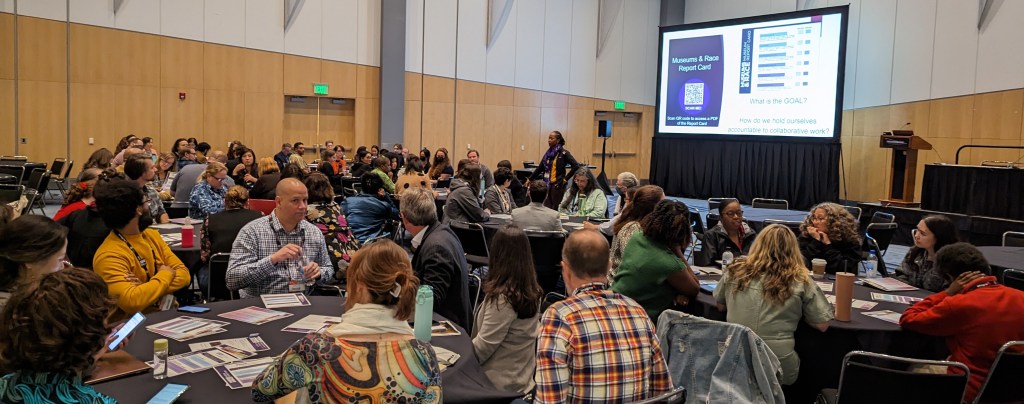
A set of conference roundtables packed with attendees. There are some papers visible on some of the tables and a slide is displayed in the background titled, "Museum & Race Report Card".

The Year That Was (2022 Review)

Happy May, y’all! It’s been a minute since we’ve posted, but we’ve been busy behind the scenes. We wanted to drop a note about what we’ve been up to and what we’ve got coming up this year, and we’re hoping to connect with some of you this next year in person and online.

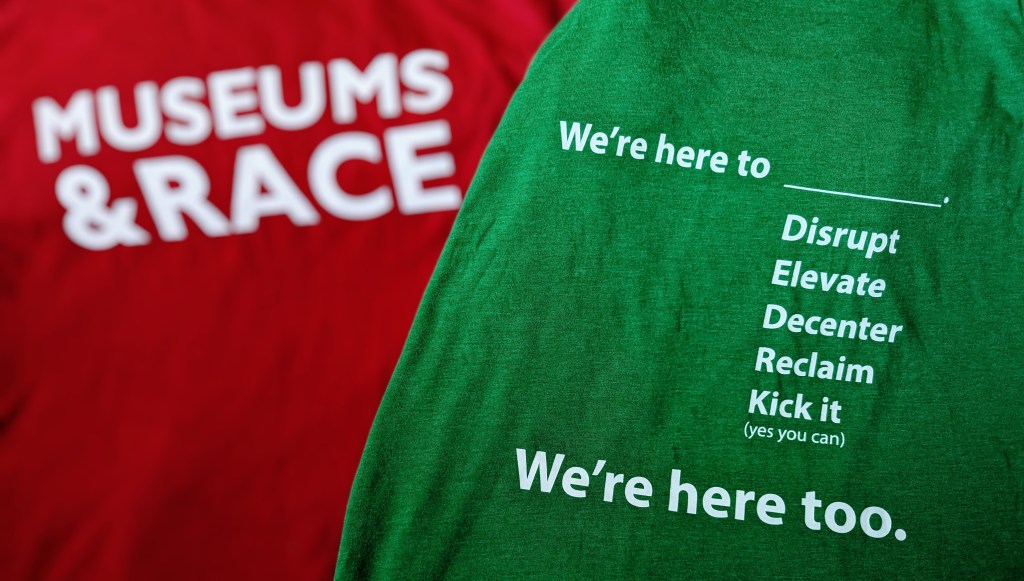
Museums & Race
We're here to _.
Disrupt
Elevate
Decenter
Reclaim
Kick it
(yes you can)
We're here too.

Over this past year, multiple organizations have reached out to us to support them in their anti-racist journey and to help make concrete structural changes. We’re happy to share that we’ve used the Museums & Race Report Card to forge a community of practice. In partnership with Brooke Hutchison, we facilitated a course at Bank Street Graduate School of Education for current and future museum professionals. The course focused on organizational change and implementing racial equity practices. 

In partnership with Brooke Hutchison and Enrich Chicago, joined in examining the overlaps of caste, race, and white supremacy, and providing a systemic context for exploring the dynamics of each. Attendees explored these oppressive systems and their cultural contexts through the lens of racism in arts and culture. 

We’ve also met with multiple museums to address how they can integrate the Museums & Race Report Card into their strategic work. Later this year in this space, you’ll be hearing the stories of a couple of these organizations and their process towards implementing a more radical future. We’ll also be at the ASTC conference with representatives from those museums to share their perspectives and lessons learned from engaging in this work with us. As the year continues, we look forward to finding other places to connect with people throughout the museum field about our work whether that’s at conferences, online, or through new relationships.

Five people wearing masks and multicolored Museums & Race shirts looking at the camera in a conference center with a cityscape behind them.

And yes, we will be at AAM later this month. We’ve carefully considered our participation and despite some of our misgivings from past interactions, AAM remains the largest gathering of museum professionals in the country This is another example of the power imbalance between organizations and individual professionals, but the conference is one of the few ways we can find this level of community together. Our presence at the conference allows us to find like-minded professionals who are committed to forging equity and organizational anti-racist practices. 

We also remain cognizant of the fact that there are many people within AAM who are themselves working to implement a more equitable system. Much of AAM’s communications recognize this work. We hope that AAM will hold itself to a greater practice of accountability as they transition between leaders. We will continue to encourage AAM and the museum community at large to make meaningful change.

Finally, as our work continues to grow we’re looking to add new people to be directly involved in our work, later this year. Museums & Race is a non-hierarchical space, and we are mindful of the differences in each members’ time commitments. Depending on their time availability, incoming new members have the option of joining the steering committee, helping with our website, putting together conference events, or coaching sites on ways to use the Report Card. If you’re interested, keep an eye out for announcements in the space and let us know on our contact us/support us page.

Museums and Race Report Card [Now in Word!]

We were asked about our accessibility efforts last year at one of the conferences. One of the things we’ve learned is just how inaccessible pdfs can be. We’ve got a few more improvements planned for later this year based on feedback from y’all, but we wanted to get the current version (3.0) of the Report Card up and out right away in a new format.

Presenting the Museums & Race Report Card in both easy to read .docx format and pretty .pdf formats! You’ll find it in both English and Spanish. The Word doc is saved in a read only format. As always: Use it. Share it. Cite it.

The first page of the fully designed "Museums & Race Museum Report Card" PDF showing "Action Steps and Framework"
English PDF
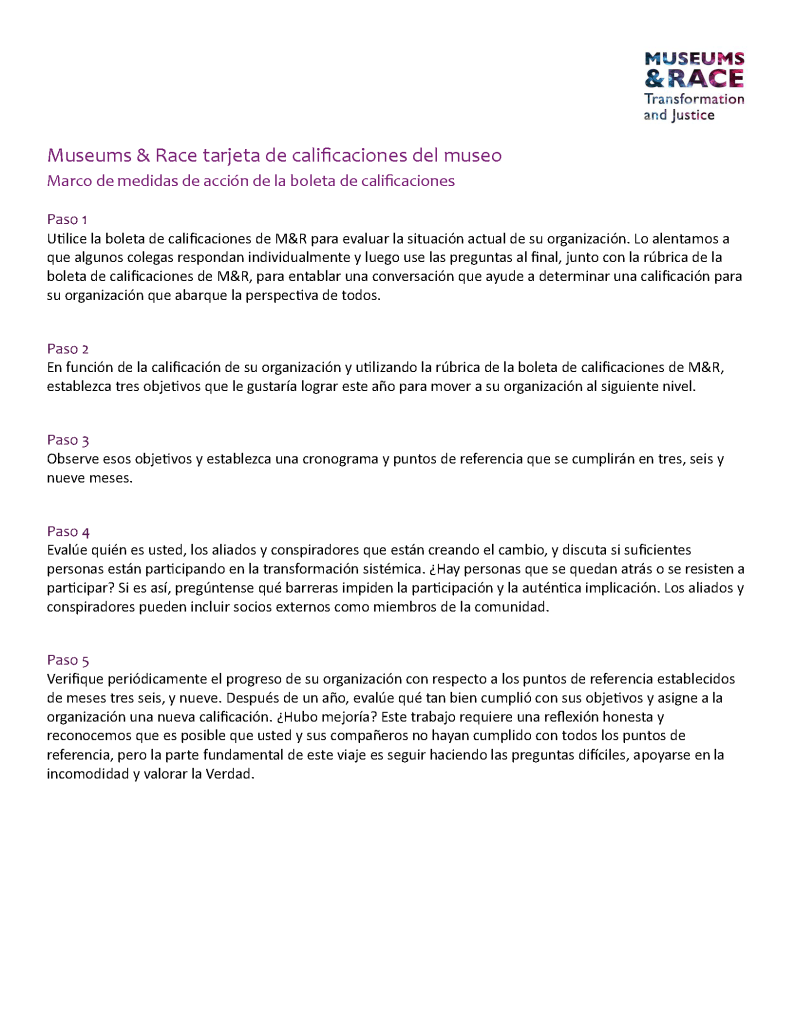
La primera página de "Museums & Race tarjeta de calificaciones" PDF monstrando "Marco de medidas de acción de la boleta de calificaciones"
Español PDF
The first page of the fully accessible "Museums & Race Museum Report Card" Word .docx showing "Action Steps and Framework"
English DOCX
La primera página de "Museums & Race tarjeta de calificaciones" word .docx monstrando "Marco de medidas de acción de la boleta de calificaciones"
Español DOCX

We’re always listening, so if you’ve got feedback on how to improve the report card, please let us know!

As a reminder, we are all volunteers and we are busy with day jobs to pay the bills. And we cycle through membership to keep folks from burning out during their careers, so some of the skills we’ve had in the past, we need again. If you’ve got the time and inclination to help out, let us know. Do you have design skills? Maybe you are a native Spanish speaker? Drop us a line!